

Real Estate Appraisal for Informed Decisions
In the institutional context, a thorough real estate appraisal is much more than simply determining a market value. It forms the basis for investment and divestment decisions, supports financing and accounting processes, and serves as a key component of risk management and real estate portfolio management.
Institutional investors, asset management firms, family offices, banks, pension funds, and project developers are regularly faced with the task of valuing individual properties, project developments, or entire portfolios under various market and usage scenarios. This requires valuation approaches that take market conditions, property-specific risks, and economic potential into account in equal measure. Valuation assumptions are critically reviewed, value-relevant factors are systematically analyzed, and transparent valuation estimates are derived that meet the requirements of investment committees, supervisory bodies, financing partners, and auditors.
Valuation is not an isolated process, but rather an integral part of investment, financing, and portfolio management decisions. The focus is on the transparency of assumptions, the traceability of the derivation, and the structured analysis of opportunities, risks, and factors influencing value. This approach provides a solid foundation for decision-making by institutional market participants in increasingly complex market and regulatory environments.
Added Value
Reliable valuation metrics provide transparency regarding the opportunities, risks, and key value drivers of a property or portfolio. This enhances the quality of investment, divestment, and financing decisions.
A transparent derivation of the valuation parameters enables the results to be validated by investment committees, supervisory bodies, financing partners, and auditors. This makes decisions documentable and robust.
The incorporation of current market information, transaction data, and property-specific characteristics ensures realistic valuations and reduces the risk of misvaluations.
Structured valuations facilitate communication with financial institutions, investors, and auditors, and provide a solid foundation for financing and accounting processes.
The systematic analysis of sensitivities, scenarios, and factors affecting value enables a well-founded assessment of risks and the identification of opportunities for value enhancement.
Particularly in the case of special-purpose properties, development projects, restructuring cases, or cross-border portfolios, a well-founded valuation supports the management of complex investment and portfolio strategies.
- Validation of value-relevant assumptions regarding rent, vacancy rates, cap rates, and market trends
- Incorporating Property, Location, and Portfolio Risks into the Valuation Context
- Reliable Valuation as a Basis for Decisions on Purchases, Sales, and Financing
- Critical Review and Assessment of External Expert Opinions and Evaluation Assumptions
- Sensitivity analyses of key value drivers and risk parameters
- Transparent communication with the investment committee, governing bodies, and financing partners
- Assistance with valuation disputes, special circumstances, and complex portfolio situations
Q&A - Frequently Asked Questions
We answer the most common questions from institutional clients regarding real estate valuation—ranging from typical reasons for valuation and methodological approaches to the interpretation of external appraisals, dealing with market volatility, and communicating with committees and financing partners.
Valuation consulting is always useful when an investment decision, financing negotiation, or regulatory requirement calls for a transparent and justifiable valuation. Typical scenarios include:
- Purchase and Sale of Individual Properties and Portfolios
- Financing Structuring and Loan Extensions
- Financial Reporting in Accordance with IFRS, HGB, or KAGB/KARBV
- Annual Portfolio Reviews for Institutional Funds
- Restructuring and Debt-to-Equity Transactions
- Arbitration proceedings, disputes among shareholders, and valuation disputes
- Due Diligence Prior to Fund Investments and Corporate Transactions Involving Real Estate Portfolios
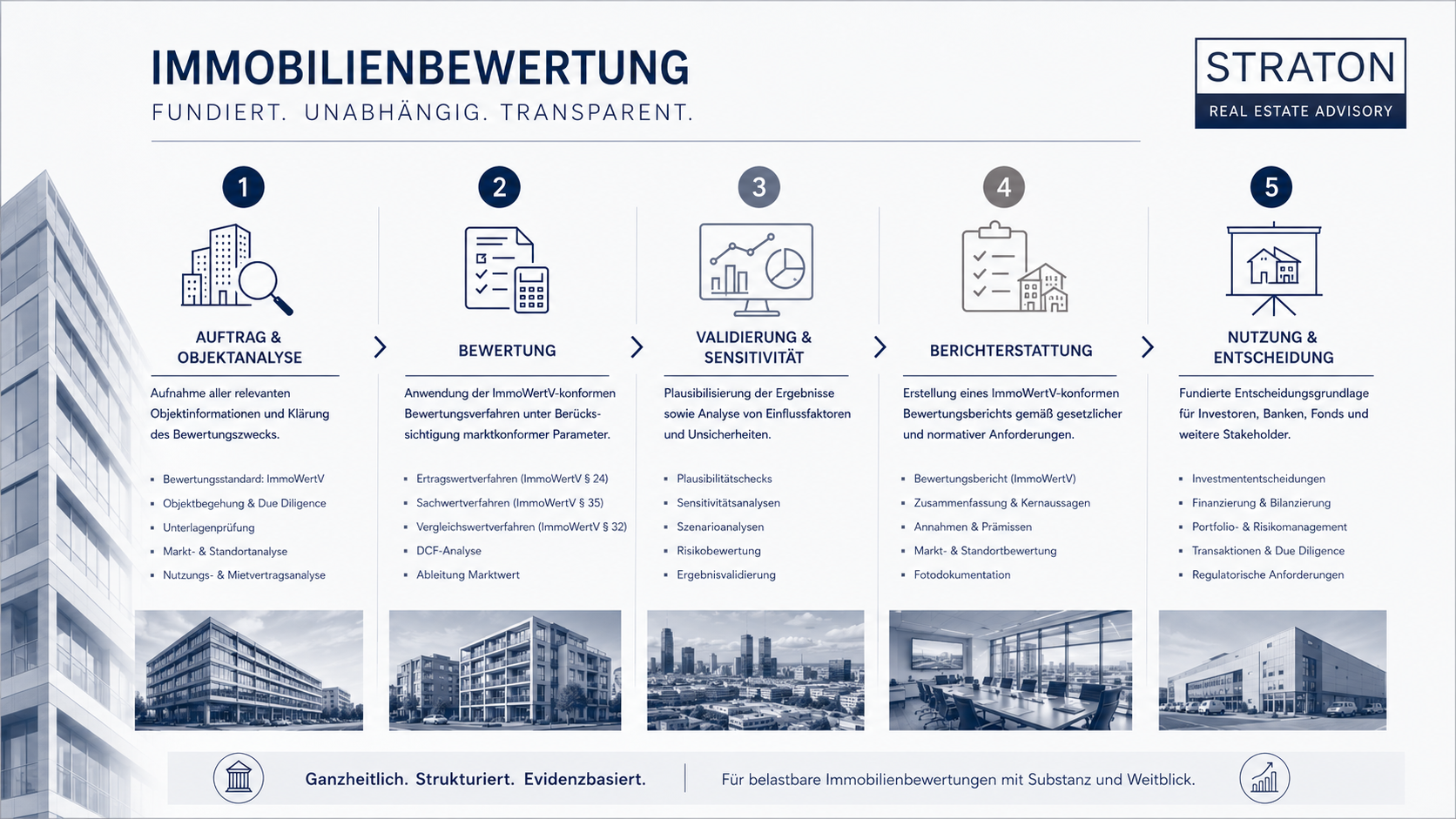
The choice of valuation method depends on the purpose of the valuation, the type of property, and the available data. In an institutional context, the following methods predominate:
- Income Approach Valuation Method Under ImmoWertV: The Standard for Existing Rental Properties in the German Market
- DCF (Discounted Cash Flow) Method: Preferred for long-term cash flow projections, development projects, and international engagements
- Comparable Sales Approach: Used as a supplementary method for residential real estate and standardized products with a sufficient database of comparable sales
- Residual Value Method: For land parcels and development projects with defined building rights
In practice, we combine several methods and disclose the valuation ranges to maximize transparency and the quality of decision-making.
For an initial assessment or valuation estimate, we typically need:
- Property Description and Floor Plans (Square Footage, Year Built, Condition)
- Lease Agreement Data (current leases, leased space, lease terms, options)
- Technical Information and Maintenance History
- Current or planned operating expense statements
- Existing funds, financing documents, or business plan assumptions
- Information on the leasing situation, vacancies, and market conditions
For more complex tasks (portfolio, development project, special circumstances), we will work with you at the outset to determine your exact information needs.
Yes—the independent review of external appraisals is an important part of our consulting services. We analyze valuation assumptions regarding market rent, vacancy rates, cap rates, maintenance costs, and discount rates, place them in their market context, and identify key sensitivities.
This is particularly relevant when external valuations are used as the basis for acquisition decisions, financing, or distribution calculations, and a second, independent assessment improves the quality of the decision. Upon request, we communicate our assessment directly to investment committees or board members.
During periods of heightened market volatility—such as when financing conditions change, discount rates rise, or market liquidity issues arise—the range of acceptable values is often wider than during stable market conditions. Our approach explicitly addresses this.
- Transparent presentation of best-case, base-case, and bear-case scenarios
- Sensitivity Analyses of Cap Rates, Rents, and Vacancy Trends
- Critical Analysis of Market Benchmarks and Comparable Transactions
- An assessment of whether and where market movements have already been taken into account in existing reports
The result is not a single number, but a well-founded valuation judgment with clearly communicated assumptions—a foundation that stands up to scrutiny by committees even during difficult market conditions.
A formal valuation report provides a number—and a formal rationale. What it rarely does is engage in a critical examination of its own assumptions, disclose sensitivities, or place the valuation judgment in a market-based context within the investment framework.
We help you understand why a property has a certain value—what the key drivers are, where the greatest risks lie, and how resilient that value is to changing market conditions. It is this depth of understanding that makes all the difference in investment committees, financing discussions, and board decisions.
Weitere Informationen finden Sie unter www.bewerter-immobilien.de