
Project Management for Institutional Real Estate Investors
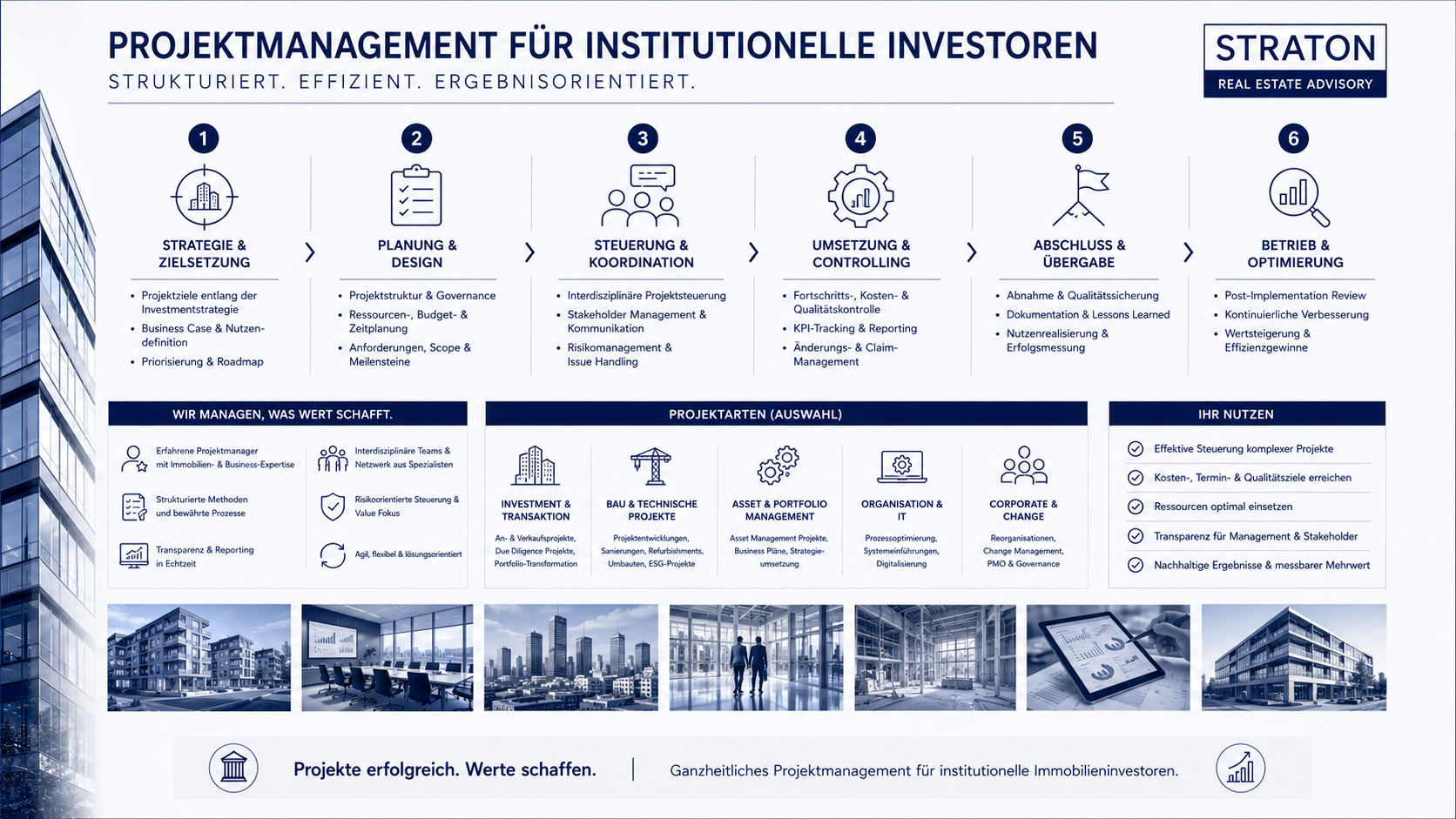
We support institutional real estate investors in the structured management and implementation of complex projects, ensuring that initiatives of high internal importance do not remain mere concepts but are successfully translated into tangible results.
We deliberately take a broader view of project management than the traditional oversight of construction or development projects. We also focus on internal corporate projects: the implementation of new reporting and data structures, process optimization, organizational and governance projects, the execution of strategic management decisions, restructuring, system migrations, and the coordination of complex cross-functional initiatives during ongoing operations.
Our task is to set up projects—both in terms of content and organization—in such a way that objectives, responsibilities, timelines, and decision-making processes are clear from the outset. This results in robust project structures that enable management, departments, external service providers, and committees to collaborate efficiently.
Added Value
In the institutional real estate sector in particular, projects rarely fail due to a lack of objectives, but rather because of coordination issues, unclear responsibilities, a lack of prioritization, or inadequate oversight. Professional project management fosters accountability, transparency, and momentum in implementation.
We ensure that projects are not only organized but also actively managed: with a robust structure, ongoing progress monitoring, a clear escalation process, and communication that meets the requirements of management, investors, and governing bodies.
- Clear project architecture with roles, responsibilities, and decision-making processes
- Effective management of internal projects across multiple departments and with external partners
- Transparent prioritization of work packages, milestones, and dependencies
- Improved reporting capabilities to management, the investment committee, and other bodies
- Greater assurance of successful implementation for strategically important change projects
Q&A - Frequently Asked Questions
The most important questions regarding project management in the institutional real estate context.
We support both traditional real estate-related projects and internal corporate projects on the investor side. These include, among other things, organizational adjustments, governance initiatives, data and reporting projects, system implementations, process harmonization, restructurings, and strategic programs involving multiple departments.
A typical feature of these projects is that they do not operate in isolation within a team, but rather have a profound impact on existing structures, decision-making processes, and operational workflows. This is precisely where we establish the necessary alignment in management, role definitions, and communication.
External support is particularly useful when projects span multiple departments, internal resources are tied up in day-to-day operations, or initiatives require a high level of visibility with senior management and governing bodies. In such situations, the issue is often not a lack of technical expertise, but rather the absence of neutral, consistent oversight across all stakeholders.
An external project management partner can help clarify priorities, mediate escalations, ensure that decisions are well-founded, and make sure that critical issues do not get lost between departments. This increases both the pace of work and the quality of results.
Depending on the scope of the assignment, we do more than just coordinate. In addition to managing schedules and tasks, we also provide substantive support in areas such as project architecture, goal definition, prioritization, decision-making logic, and management communication. This ensures that the project is not only supported administratively but is also actively steered toward achieving results.
Our goal is to effectively combine operational management with substantive content: clear enough to ensure reliable implementation, flexible enough to adapt to dynamic project situations, and robust enough to support decision-making under uncertainty.
Project success stems from clear objectives, robust accountability structures, and a management approach that makes both progress and risks equally visible. That is why we work with clearly defined work packages, transparent decision-making processes, regular management reviews, and early escalation of critical issues.
Equally important is ensuring continuity: Once a project is completed, the results must be integrated into processes, roles, and systems. A project is only truly successful in our view once it has been successfully implemented in day-to-day operations.